

 Trading Platform
- Best for
- Meme coin traders
- Pricing
- Platform access and trading costs vary; verify current network and service fees
- Networks / Availability
- Solana, BNB Chain, Base, Ethereum and other supported chains
A wallet you follow buys a new meme coin. The chart starts moving, but before you do anything, you want to know whether the token is real, how much liquidity is available, and whether you’re already late.
GMGN meme coin trading is built for that moment: it puts token discovery, wallet activity and on-chain trading in the same interface.
GMGN is primarily a meme-coin trading terminal, not a traditional crypto exchange. Its job is to help you investigate and trade tokens launched on sites such as Pump.fun.
GMGN also offers a “Cooking” workflow for preparing new token launches, but the launchpad itself handles the deployment. The attraction is fewer tabs between noticing a trade and making your own decision—not a promise that you'll catch the next 100x coin.

How GMGN meme coin trading works
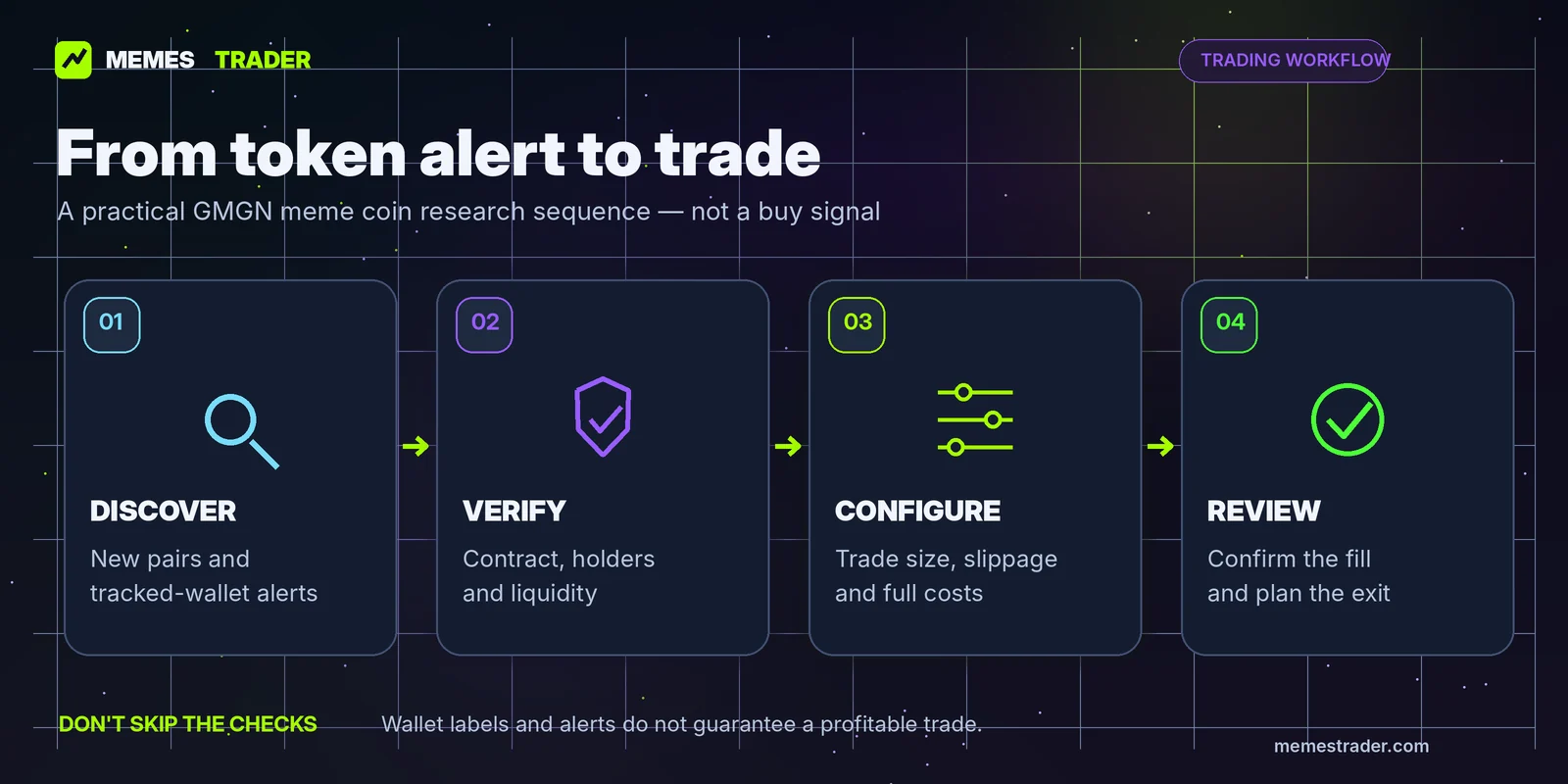
Suppose a wallet GMGN labels as “smart money” buys a freshly launched Solana token. You can open the address, review its recent activity and follow the trail to that token’s page.
But the wallet’s label is a starting point, not a recommendation. You don’t know the owner’s whole strategy, what they bought elsewhere, or whether they’re about to sell.
The first useful checks are simple: confirm the exact token address and network, look at pool liquidity, examine who owns large portions of the supply, and see whether the recent activity comes from a handful of related wallets.
A token with a busy chart can still be impossible to exit at a reasonable price. GMGN brings much of this information close to the trading controls, though important details are worth checking against a blockchain explorer.
If the numbers still make sense, the trading panel lets you configure the swap rather than leaving the platform to execute it elsewhere. That matters during fast launches—but so do the settings.
An order’s slippage tolerance, priority fee and routing can change the execution you actually get. The quoted price on the screen is not a guarantee of your fill.
What does trading on GMGN cost?
GMGN’s published fee guide describes a 1% platform fee per transaction. On a $200 buy, that works out to about $2 for GMGN itself. If you later sell $200 worth of the token, the platform fee would be about another $2.
That’s roughly $4 for the round trip at an unchanged $200 notional on each side—before considering anything else. The actual total varies with the sale amount and trading route.

There can be more costs than that headline 1%. A swap may also involve a launchpad or liquidity-pool fee, the blockchain network fee, optional priority fees or tips, and an unfavorable fill caused by thin liquidity.
These aren’t all fees collected by GMGN, and they aren’t all calculated the same way. A newly launched token on a bonding curve can have a different fee structure from a token already trading in a DEX pool.
One setting deserves special attention: slippage tolerance. A 10% tolerance doesn’t mean you automatically pay a 10% fee. It means you’re allowing a trade to execute within a potentially very wide price range.
In a volatile, shallow market, the difference can be expensive. Before hitting Buy, check the expected output and total transaction details—not just GMGN’s commission percentage.
Wallet tracking versus copy trading
Watching a wallet and copying its trades are two different activities. With wallet tracking, you receive information and decide what to do.
With copy trading, you configure rules that may place trades when the watched address trades. GMGN supports both approaches, including tracked-wallet alerts and automated execution controls.
Here’s the trap with simply copying a profitable-looking address: your order is a second trade. The original wallet may have bought before the token surged, while your copy order arrives into a thinner pool at a higher price.
On the way out, the wallet may also sell faster than the followers who copied it. A reported wallet profit is not a forecast of the return you’ll receive.
Even well-configured automation has limits. Transactions can fail, trading conditions change, and some copy tasks pause after repeated execution failures.
It makes sense to study the tracked wallet’s history and the liquidity of the tokens it trades before deciding whether automation adds value. GMGN’s copy-trading feature is convenient, but convenience shouldn’t be confused with an edge.
The Telegram bot has a different wallet trade-off
GMGN is available through web and Telegram interfaces, and that choice matters for more than convenience. Connecting your own compatible web wallet isn’t the same experience as funding a wallet created for a trading bot. The recovery methods and control over keys can differ.
One detail in GMGN’s Telegram-wallet documentation is particularly important: it says private keys from those bot wallets cannot be exported, including keys imported from outside. That limits portability.
It doesn’t necessarily mean you can’t withdraw your assets, but it does mean you shouldn’t assume you can restore a bot-created wallet in another app the way you might restore a conventional wallet from a seed phrase.
Before sending funds to a bot wallet, check how you would regain access if your Telegram account were lost, whether you can withdraw assets to an external address, and exactly what trading permissions you’ve enabled.
Use only bot links reached through GMGN’s official website or documentation; impersonation is a serious issue around trading bots.
Is GMGN the right platform for you?
GMGN makes the most sense for active meme-coin traders who want token discovery, wallet monitoring and on-chain execution in one workflow. It can save time if you’re already comfortable assessing token addresses, liquidity and transaction costs.
Its web terminal and bot features also make it more specialized than a conventional exchange focused on major cryptocurrencies.
If you only want to see which tokens are moving and compare liquidity, a scanner such as DEX Screener or GeckoTerminal may be enough without placing trades through a full terminal.
If you want to compare execution interfaces, Axiom, Photon and Trojan serve related audiences, but their costs, chains, wallet arrangements and automation choices need to be compared on current terms rather than on hype.
The most useful way to evaluate GMGN is to walk through a real token you understand without rushing to place a trade.
Can you confirm the contract and follow the wallet activity? Do the trade settings and full cost make sense? Would you be comfortable with the wallet and recovery arrangement?
If GMGN helps you answer those questions and execute deliberately, the integrated interface has value. If it only makes it easier to chase every alert, it may simply help you trade faster—not better.