

 Wallet & Storage
- Best for
- Self-custody with card-based hardware backups
- Pricing
- One-time hardware wallet purchase; free companion app
- Networks / Availability
- Bitcoin, Ethereum, Solana and other supported networks; verify the exact asset and chain
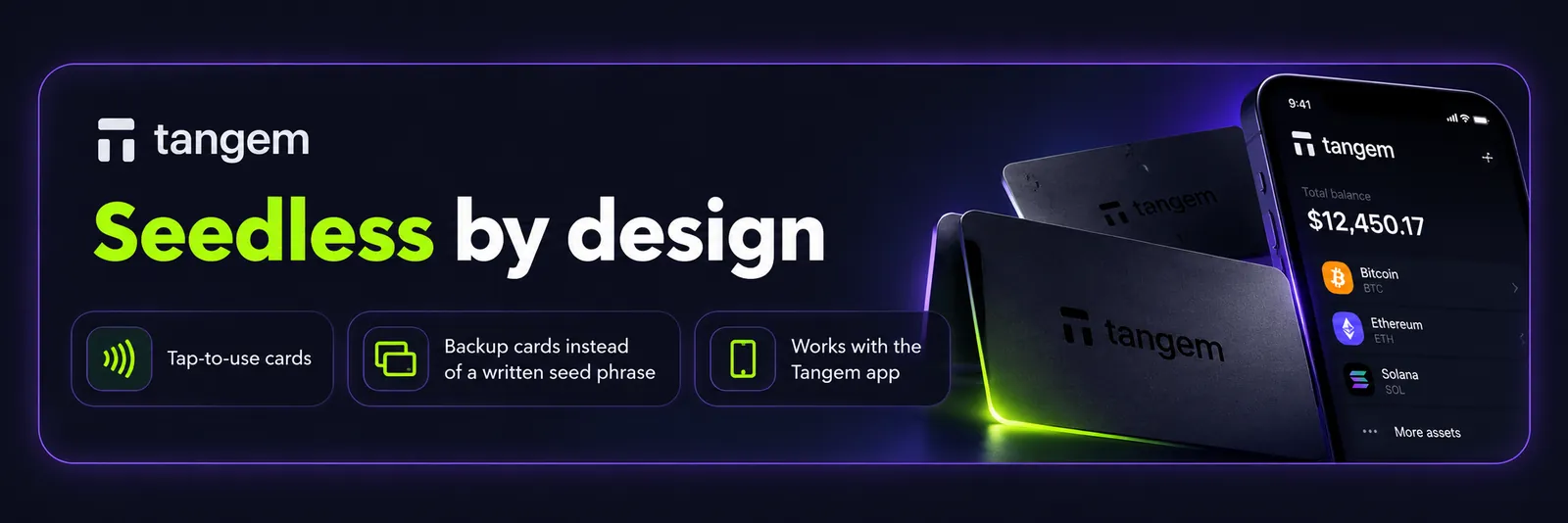
Tangem's most interesting feature isn't that its crypto hardware wallet looks like a bank card. It's that you can protect your crypto without relying on a handwritten seed phrase. Instead, you can use two or three linked Tangem cards as backups. For anyone nervous about misplacing—or exposing—a recovery phrase, that's an appealing idea. But it replaces one recovery problem with another: what happens if the cards themselves disappear?
That's the question worth answering before you buy one.
How the Tangem crypto hardware wallet works
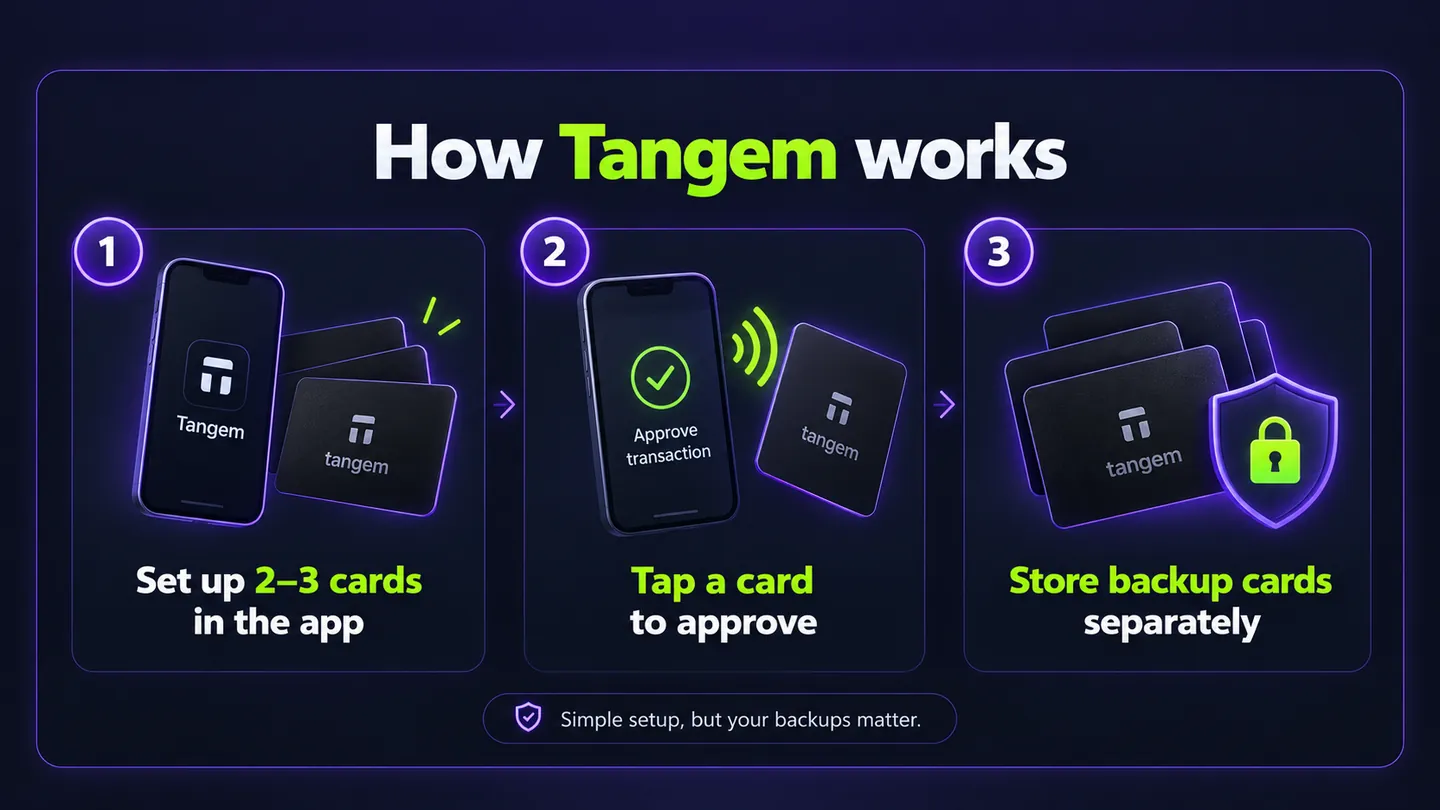
A Tangem hardware wallet consists of an NFC card or ring and a mobile app. The app shows balances, helps prepare transactions, and lets you choose what to send. When it's time to approve a transaction, you tap the physical device against your NFC-enabled phone. The device handles the cryptographic signing, while the phone provides the screen and internet connection.
This is different from leaving coins on an exchange. With Tangem's hardware wallet, the wallet keys are controlled by your hardware devices rather than an exchange account. It also differs from a browser wallet: a website or phone app cannot simply sign a transaction without the physical Tangem device and required authorization.
The card has no battery or built-in display, which makes it easy to carry and eliminates charging. The trade-off is that you review transaction details on your phone, not on an independent hardware screen. People who want to verify destination addresses and amounts on a separate device may prefer a traditional screen-equipped hardware wallet.
How Tangem seedless recovery works
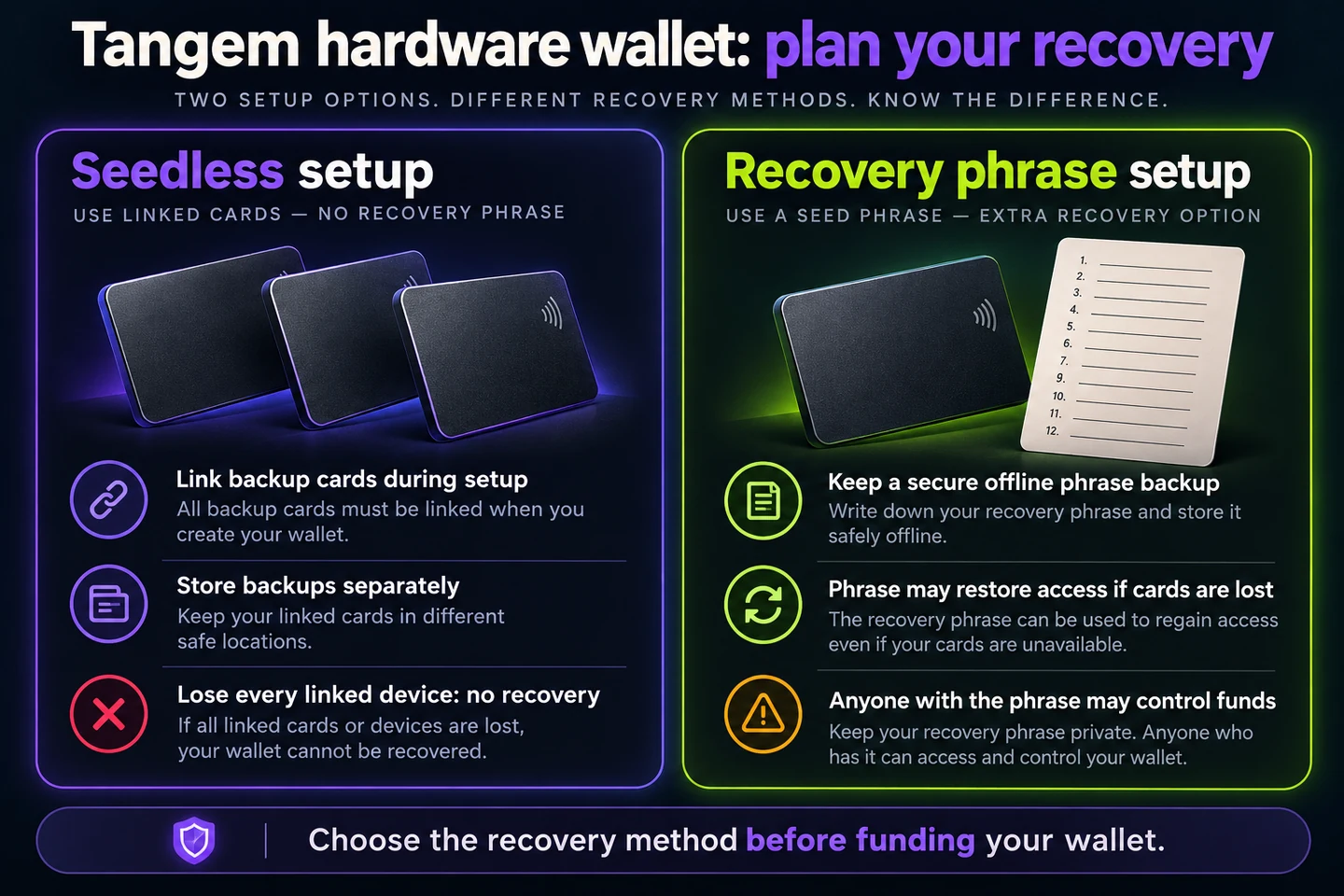
Tangem's default seedless setup links your cards or ring to the same wallet during activation. There's no special “master card”: each linked device can authorize transactions. A three-card set offers an extra physical backup over a two-card set, provided those cards are stored separately.
Here's the catch. You must link the backup devices during the original setup. Once you finalize a seedless wallet, you cannot buy another Tangem card later and simply attach it to the existing wallet. If you're down to one working card, the safer long-term plan is usually to establish a new wallet with a complete backup set and transfer your funds while you still have access.
Tangem also offers a setup using a recovery phrase on supported newer hardware. That changes the risk: a safely stored phrase may allow recovery if every physical device is lost, but the phrase itself becomes highly sensitive. Anyone who obtains it could potentially restore the wallet. Neither approach eliminates responsibility; it changes what you need to protect.
What happens if you lose a card, phone, or access code?
Lose your phone? Your hardware-wallet keys aren't stored there, so you can install the app on another compatible phone and use a linked card. Lose one of three cards? The other linked devices continue to work. You should still think about how the missing card was lost, especially if someone else may know the access code.
Lose every linked device in a seedless setup? There's no recovery phrase to fall back on, and Tangem cannot restore access for you. This is the most consequential difference from a seed-phrase wallet. The coins aren't “inside” the missing card; they're on their blockchains, but nobody can authorize moving them without the keys.
Forget the access code? Tangem provides a reset procedure that normally requires the affected card and a second linked device with code recovery enabled. That makes retaining multiple cards important even if you never lose one. Don't assume your last surviving card can always reset its code by itself.
Tangem's mobile-only wallet isn't the same product
The Tangem app now offers a separate Mobile Wallet that works without purchasing an NFC card or ring. Its keys are stored in the phone's protected environment, and its recovery method uses a seed phrase. That's a software-wallet experience, not the hardware isolation described above.
If you're comparing products, ask whether you're looking at Tangem's hardware cards or the phone-only wallet. The distinction affects where signing keys live, whether a physical tap is required, and how you recover after losing the device.
Who is the Tangem hardware wallet best for?
Tangem makes sense for someone who wants to move long-term holdings away from an exchange, prefers a phone-based experience, and is willing to manage physical backups carefully. It can be particularly attractive if the conventional seed-phrase process is what's been keeping you from trying self-custody.
It's a weaker fit for someone who wants a screen on the hardware wallet itself, needs rapid desktop-based signing throughout the day, or is uncomfortable with the consequences of losing all seedless backup devices. A different hardware wallet—or a deliberately chosen recovery-phrase setup—may be the better match.
As of October 26, 2026, Tangem listed two-card packs starting at $54.90 and three-card packs at $69.90 on its US pricing page, before applicable taxes or duties. Prices change; check the current total rather than relying on a review's quoted price. The difference between the packs isn't a new feature so much as one additional chance to retain access if a card is lost or damaged.
Before sending a meaningful amount of crypto to any new wallet, confirm support for the exact coin and network, verify the receiving address, and make a small test transfer. That's especially important with assets that exist on multiple blockchains. A wallet supporting an asset name doesn't mean every network version of that asset is interchangeable.
The bottom line
Tangem's appeal is genuine: hardware-backed signing without cables, charging, or a mandatory paper seed phrase. Its biggest weakness isn't day-to-day usability; it's how unforgiving a lost seedless backup set can be. If you choose it, decide on recovery first, set up every backup device before moving funds, and store the devices separately. The best wallet isn't the one with the slickest setup. It's the one you can still recover when something goes wrong.